01
Value hypothesis
Maps account context to approved value buckets before a seller builds a business case.
Value Demo
A fictional walkthrough of how PRA turns value engineering into usable GTM artifacts: outside-in value hypotheses, discovery prep, ROI logic, executive business-case structure, and governance review.
Widget Co and Acme Services Group are illustrative. The numbers below are demo values, not PRA performance claims or customer benchmarks.
Artifact Viewer
Scan through the kinds of executive-ready artifacts a governed value motion can produce.
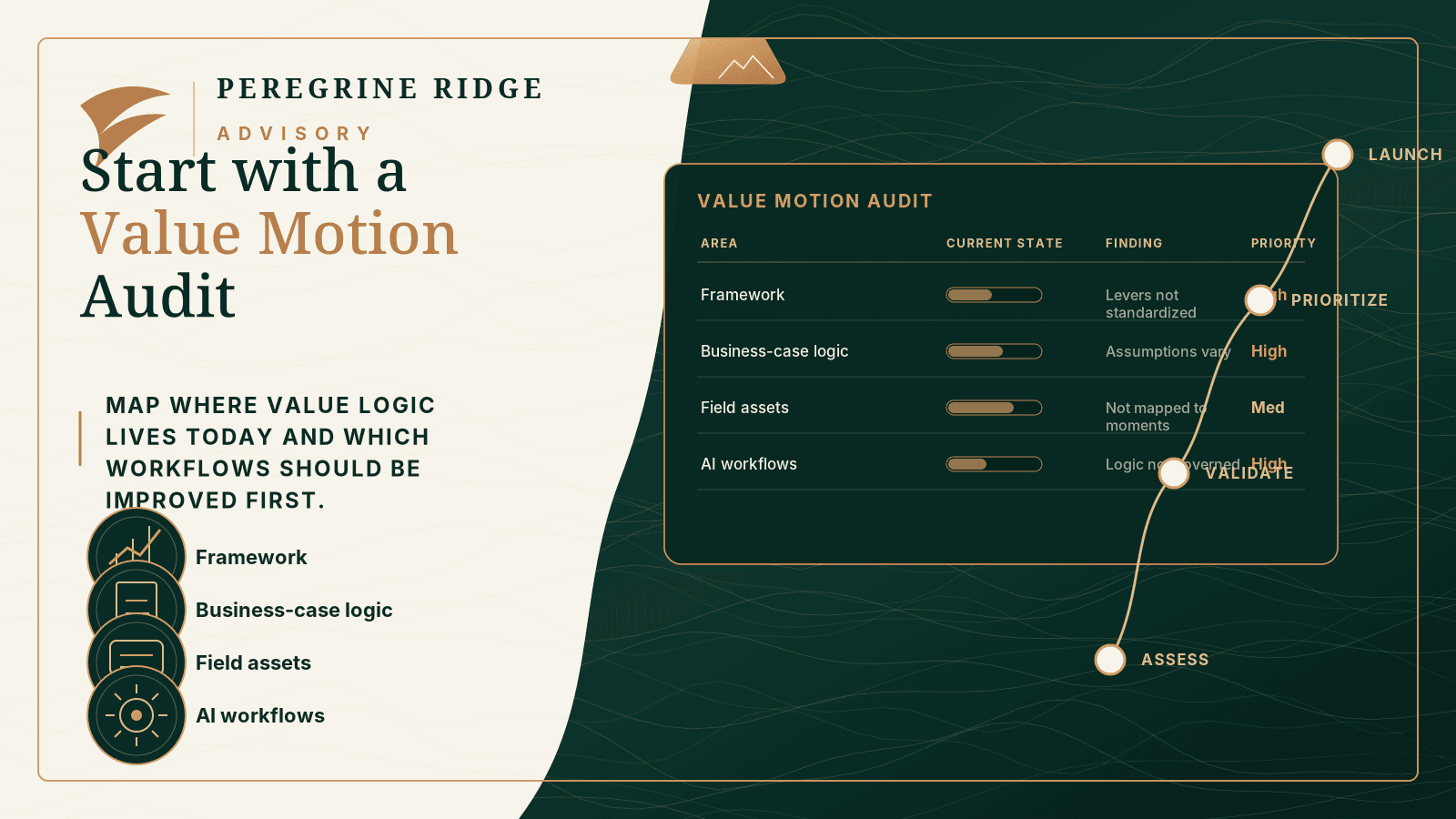
01 / 06
A first-step artifact that maps where value logic lives today and which workflows should be prioritized.
What This Proves
01
Maps account context to approved value buckets before a seller builds a business case.
02
Turns likely value levers into persona-specific questions and missing-input checks.
03
Keeps financial outputs tied to approved formulas, assumptions, scenarios, and review flags.
04
Rejects unsupported claims and gives the seller safer language before customer use.
Demo Runs
01 Demo Run
Prompt
Create a discovery guide for Acme Services Group. Organize questions by value pillar and identify the metrics needed to validate the business case.
Expected output
A VP Operations discovery guide organized around productivity, service reliability, technology simplification, and revenue protection.
02 Demo Run
Prompt
Generate a base-scenario ROI summary using approved Widget Co assumptions. Show value by pillar, investment, payback, ROI, assumptions, and review flags.
Expected output
An illustrative base case showing potential annual value by pillar, first-year investment, payback, ROI, and assumptions requiring validation.
03 Demo Run
Prompt
Create a six-slide executive business case deck outline for the VP Operations and CFO. Include headlines, bullets, speaker notes, and review caveats.
Expected output
A review-ready deck outline with executive summary, current-state challenge, value hypothesis, quantified estimate, assumptions, and next steps.
04 Demo Run
Prompt
Review a risky claim for unsupported guarantees, risky language, missing inputs, and assumptions that require validation before customer use.
Expected output
A governance check that rejects unsupported claims and provides a safer rewrite.
Illustrative ROI Logic
The demo output keeps assumptions visible: value lever, required input, formula, scenario treatment, and review flag. That lets a seller move faster without treating an early hypothesis as a finished business case.
Executive Asset
The deck is still a draft. Its purpose is to give the account team a disciplined structure for executive review, not to bypass value engineering or finance approval.
Operating capacity and service reliability opportunity
Manual routing and fragmented workflow visibility
Capacity, reliability, tool simplification, and revenue protection
Illustrative annual value by pillar and investment summary
What is approved, what is directional, and what needs validation
Focused value working session to validate the case
Governance Review
In the demo, the system rejects an unsupported claim instead of making it sound polished. That is the point: useful speed with visible commercial discipline.
Rejected claim
Widget Co will eliminate the need for 10 operations headcount and guarantee $1M in retained revenue.
Why it fails
Safer treatment
Frame the business case as a validated-capacity and renewal-risk hypothesis until operations, finance, and revenue leadership confirm the affected population, manual handling burden, ARR at risk, and proof.
Commercial Outcomes
Model sales-cycle reduction, days-to-revenue impact, and faster approval paths.
Model discount reduction, margin protected, pilot avoidance, and scope expansion.
Model hours saved per opportunity, per rep, and per repeatable GTM task.
Model internal build cost, opportunity cost, timeline reduction, and faster time-to-launch.
Next Step
Request a Value Motion Audit to identify the strongest use case, the inputs needed to quantify it, and the first repeatable GTM task worth building.